
Article
How to get more from your home battery with variable electricity prices
A home battery can do more than store electricity from your solar panels. With smart control, it can also help you buy electricity when it is cheap and use it when it is expensive. But that takes more than a simple schedule.
- Buy electricity when it is cheap
- Use solar energy when it is available
- Store energy for expensive hours
- Let the controller learn about your home
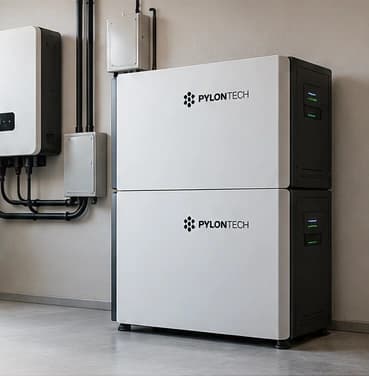
AI-generated illustration — not a photograph of the measured installation.
A real example: 26 October 2026
In a Danish home with solar panels, a home battery and Fluks, the electricity price on 26 October 2026 ranged from around DKK 0.45/kWh at night to DKK 3.03/kWh in the late afternoon. The price difference was approximately DKK 2.58/kWh.
- Lowest price
- 0.45DKK/kWh
- Highest price
- 3.03DKK/kWh
- Difference
- 2.58DKK/kWh
Electricity prices on 26 October 2026
Energy consumption, solar production and the battery
Solar panels, the battery and the grid worked together throughout the day. The measured daily energy totals appear beside the approximate illustration.
Energy flows on 26 October 2026
- Battery charging
- Grid electricity imported
- Solar production
- Grid electricity exported
- Battery discharging
At night: charging at low prices
The energy chart shows clear battery charging in the early hours, when electricity cost around DKK 0.45–0.55/kWh. Buying electricity then can be worthwhile if the stored energy later replaces more expensive purchases. But completely filling the battery is not always best.
At midday: solar panels contribute
The solar panels produced 19.1 kWh, mainly around midday. Some energy was used in the home, and electricity was also exported to the grid. A good plan must therefore consider how much solar energy is expected and how much battery capacity should be reserved.
In the evening: the battery supplies energy
From around 17:00, electricity prices reached just over DKK 3/kWh. The energy chart also shows battery discharging in the evening. This illustrates the opportunity to use energy at different times from when it was purchased or produced.
Fluks’ energy forecast for 28 October 2026
Fluks: smart energy optimization without complicated setup
Fluks combines electricity prices, forecasts and observed energy measurements to plan household energy use as a whole. When relevant devices are available and supported, the battery, solar panels, electric vehicle and heating can be included in one plan.
Energy forecast and plan
- Consumption forecast
- Solar forecast
- Planned grid imports
Illustration: Fluks’ energy forecast from 28 October 2026 shows expected consumption, solar production and planned grid imports. This is a different day from the measurements above.
Electricity prices vary throughout the day. Solar production and household energy use also change continuously. Good battery control is therefore about storing the right amount of energy for the right times.
A home battery should do more than charge when electricity is cheap
Imagine electricity costs DKK 0.50 per kWh at night and DKK 3 in the evening. Charging at night and using that energy in the evening seems obvious. But if plenty of sunshine is expected the following morning, a full battery may mean selling surplus solar electricity to the grid at a low price.
Conversely, waiting for the sun can be a mistake if the day turns cloudy and the battery is not charged in time for expensive hours. The best decision therefore depends on electricity prices, the solar forecast, expected consumption, the battery’s state of charge and the costs of shifting energy.
How much can you save?
If electricity bought at DKK 0.45/kWh replaces electricity costing DKK 3.03/kWh, the immediate price difference is DKK 2.58/kWh. For 10 kWh, the theoretical difference is DKK 25.80. This is not an actually measured saving. Battery efficiency, wear, tariffs, taxes and any lost solar export revenue must also be included.
Smart control should therefore avoid unnecessary battery cycles when the expected benefit does not outweigh the costs.
Why fixed schedules are not always enough
A rule to charge between 01:00 and 05:00 and discharge between 17:00 and 21:00 may work on some days, but not all. Prices, weather, solar production and household needs change. A day with expensive morning electricity may need a different plan from one with expensive evening hours.
It is therefore useful to plan for the coming hours and recalculate the plan when new information changes its assumptions.
The home needs to learn about itself
A home battery is part of a larger energy system. A heat pump, electric vehicle and ordinary household consumption affect when energy is most valuable. By learning from real measurements, the controller can improve its expectations of both consumption and solar production.
What should you look for?
- Is the battery charged at economically worthwhile times?
- Is there room for the expected solar production?
- Is energy left for the most expensive hours?
- Are losses and wear taken into account?
- Does the plan adapt when prices and consumption change?
A home battery is most valuable when it thinks ahead
A home battery is more than storage. It is an opportunity to move energy to the times when it has the greatest value. The example from 26 October shows both large price changes and the interaction between night-time charging, solar production and battery discharging.
What matters is not charging and discharging as much as possible, but using the battery’s capacity when it makes economic sense.
Your energy. Decides together.
Read more at fluks.one